
by Caren Almiñe
We often perceive nature as separate from our daily business operations and financial systems. In reality, it is the very backdrop of our societies, our economies, and our financial systems. This fundamental connection is currently facing an
unprecedented crisis. Nature is deteriorating at an alarming pace, and the loss of our biodiversity accelerates faster than at any other time in human history.
This isn’t an environmental concern only; the growing crisis poses significant and escalating risks to businesses, investors, and economies, as well as to the stability of our financial systems. Along with these risks emerge new opportunities as the shift towards a nature-positive economy approaches. Many companies and financial institutions are still at the very early stages of preparing for this reality.
Inspired by valuable lessons from climate-related financial disclosures, new frameworks and guidance are being developed to aid the finance and business sectors in integrating nature into core decision-making processes. Through our exploration together, you will be introduced to key vectors for businesses, national
economies, and the broader world of finance. We will explore what we mean by nature dependencies and impacts, and how these translate into tangible risks and opportunities.
Core concepts of Nature
Biodiversity – “The variability among living organisms from all sources, including, inter alia, terrestrial, marine and other aquatic ecosystems and the ecological complexes of which they are part; this includes diversity within species, between species and of ecosystems.” (CBD, 1992)
Ecosystems – A dynamic complex of plant, animal and microorganism communities, and the non living environment, interacting as a functional unit (CBD, 1992).
The Biosphere – “The living world; the total area of the Earth that is able to support life.” (Levin, 2009)
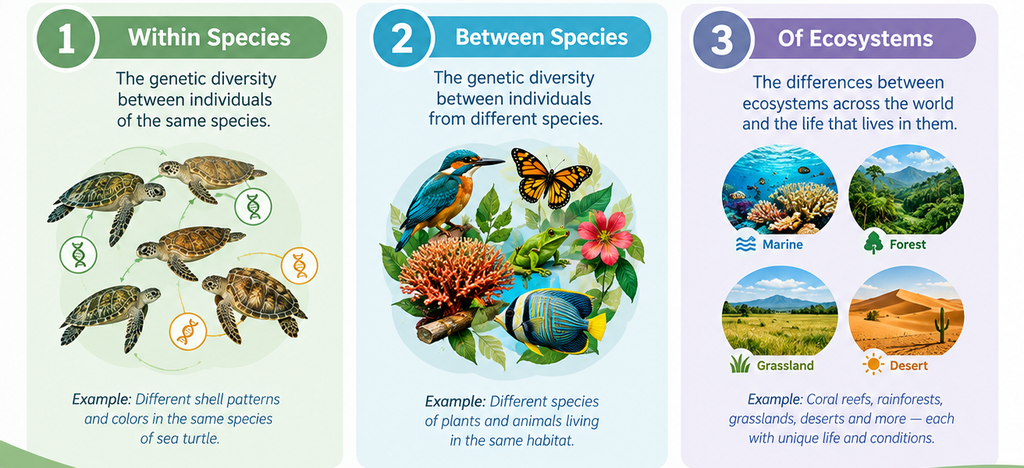
Biodiversity is an essential characteristic of nature, which enables ecosystem assets to be productive, resilient and able to adapt to change. It is crucial to maintaining the quality, resilience and quantity of ecosystems. It exists on three levels:
- Within Species: The genetic diversity between individuals of the same species.
- Between Species: The genetic diversity between individuals from different species.
- Of Ecosystems: The differences between ecosystems across the world and the life that lives in them.
The Architecture of Nature
Nature can be understood through a construct of four realms. They are major components of the natural world that differ fundamentally from each other in their organization and function (TNFD, 2022). The four realms are:
| 1. Land Terrestrial ecosystems, including forests, grasslands, and soils. | 2. Ocean Marine ecosystems, comprising open oceans, coral reefs, and deep seas. |
| 3. Freshwater Rivers, lakes, seasonal wetlands, and groundwater systems. | 4. Atmosphere Included to reflect issues like air pollution and the vital climate-nature nexus. |
The atmosphere is included in the TNFD framework both to address issues such as air pollution and to reflect the close and indispensable association between climate and nature-related risks and opportunities.
Biomes and Ecosystems
The next level down from realms is biomes. Biomes refer to large, distinct biological communities that have formed on the planet in response to similar physical environments. They exist at the global scale, and are generally defined by the type of plant life they support, average rainfall patterns, and average temperature patterns (e.g., tundra, coral reefs, or savannas).
One of the most useful units of nature is an ecosystem. Examples include sand dunes, coral reefs, prairies, and seasonal freshwater lakes.
Natural Capital
As nature is an asset, it is sometimes called natural capital just like produced capital (roads or buildings) and human capital (health, knowledge and skills). Natural capital is defined as:
“The stock of renewable and non-renewable natural resources (e.g., plants, animals, air, water, soils, minerals) which combine to yield a flow of benefits to people.”
Natural capital can be thought of as stocks of environmental assets giving rise to associated flows of benefits to people and the economy. The UN SEEA defines an environmental asset as the naturally occurring living and non-living components of the Earth, which may provide benefits to humanity.
Ecosystem Services and the Current Crisis
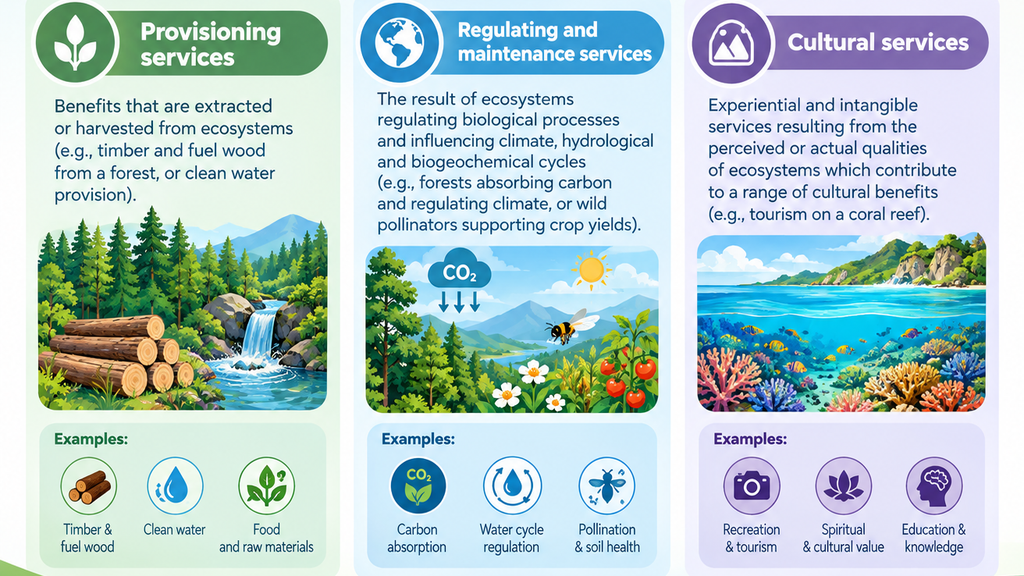
The flows of benefits that environmental and ecosystem assets provide to people are called ecosystem services. There are three primary types of ecosystem services:
- Provisioning services: Benefits that are extracted or harvested from ecosystems (e.g., timber and fuel wood from a forest, or clean water provision).
- Regulating and maintenance services: The result of ecosystems regulating biological processes and influencing climate, hydrological and biogeochemical cycles (e.g., forests absorbing carbon and regulating climate, or wild pollinators supporting crop yields).
- Cultural services: Experiential and intangible services resulting from the perceived or actual qualities of ecosystems which contribute to a range of cultural benefits (e.g., tourism on a coral reef).
Environmental assets combine to enable the flow of ecosystem services which in turn deliver economic value. For example, a water utility or beverage company depends on the ecosystem service of clean water provision, which derives from healthy terrestrial and aquatic ecosystems. The degradation of peatlands
leads to water sedimentation and deterioration of water quality. Restoration of habitats and preservation of biodiversity could reduce water quality deterioration, reducing the operational costs of water treatment.
The Nature Crisis
The latest science is clear that the natural world is in crisis. Nature is declining at an unprecedented rate. A major driver of this crisis is the way nature is valued in political and economic decisions. If business as usual continues, scenario projections look bleak:
Projected Impacts of Inaction
- Species Loss: 83% of wild mammals and 50% of plants have already been lost, and global ecosystems have declined in size and condition by 47% compared to estimated baselines.
- Land Degradation: 50% of agricultural land in Latin America will be degraded by 2050, and two-thirds of land in Africa is already degraded.
- Economic Cost: In a scenario of collapse in ecosystem services, global real GDP could decrease by US$ 27 trillion (minus 2.4 percent) compared to the baseline.
Dependencies, Impacts, and Risks
All economic activities depend on nature. This means that all corporates and financial institutions are reliant on nature. A nature-related dependency is an aspect of ecosystem services that an organisation relies on to function. Dependencies can be:
- Direct: A dependency that directly affects the assets and operations of a market actor (e.g., water supply to a factory).
- Indirect: A dependency affecting a supply chain, indirectly affecting the actor (e.g., a decline in pollinators causing a poor fruit harvest, impacting a supermarket’s supply).
Nature-Related Impacts
Impacts are changes in the state of nature, which may result in changes to the capacity of nature to provide social and economic functions. They can be positive or negative, and are classified as:
- Direct: Caused by a business activity with a direct link (e.g., a factory polluting a river).
- Indirect: Caused by a business activity with an indirect link (e.g., desertification accelerated by supply chain emissions).
- Cumulative: Caused by the interactions of different actors in a landscape which cannot be directly attributed to one organisation alone.
Nature-Related Risks
When dependencies and impacts are brought together, they expose an organisation to nature-related risk—a potential threat linked to an organisation’s dependencies and impacts on nature. There are three main categories:
- Physical risk: Vulnerability caused by damage to natural capital and a decline in ecosystem services (e.g., dwindling water supply causing shortages for cooling a power plant).
- Transition risk: Risks resulting from a misalignment between an organization’s strategy and the changing regulatory and policy landscape (e.g., new policies banning harmful fertilizers).
- Systemic risk: Risks arising from the breakdown of entire systems. Characterized by tipping points combining to produce cascading failures (contagion) as one loss triggers others.
Opportunities and Materiality
Investing in solutions to address nature loss will be one of the largest commercial opportunities in our lifetime. Fundamentally altering economic activity requires new business models and new investments. Nature-related opportunities are activities that create positive outcomes for organisations and nature by avoiding or reducing impact on nature or contributing to its restoration. The World Economic Forum has estimated that US$10.1 trillion could be generated in annual business value by 2030 from taking nature-related opportunities and contributing to the nature-positive transition.
Key pathways include:
- Nature-based solutions: Actions to protect, sustainably manage, and restore ecosystems that address societal challenges effectively, simultaneously providing human well-being and biodiversity benefits (e.g., green roofs in cities to abate pollution and manage heat).
- Natural-climate solutions: A subset of nature-based solutions focused on increasing carbon storage, avoiding greenhouse gas emissions, and assisting climate adaptation across global habitats.
The Concept of Materiality
All organizations report information to stakeholders through formal disclosures based on the principle of materiality. Materiality filters what information is significant to an organization’s stakeholders and their decision-making. There are different approaches to applying materiality to nature-related issues among standard-setters:
| Financial Materiality | Impact Materiality |
| Focuses on how dependencies and impacts on nature create risks and opportunities for an organization’s financial position. Used by standard-setters like the ISSB and SEC. | Focuses on whether a company’s activities significantly impact the economy, environment, and people. Used alongside financial materiality by EFRAG (creating “Double materiality”). |
Materiality is foundational to the standards currently being developed around the world, including the global baseline by the ISSB, the European baseline by EFRAG, and national regulations from various financial supervisors globally.
The Need for Disclosure and TNFD
Disclosure is the foundation of audit and accounting practices. Nature-related disclosure is a necessary condition for financial markets to sufficiently value and price nature-related issues and manage them effectively. High-quality disclosures enable more informed capital allocation decisions, help investors evaluate impacts on future cash flow, and ensure compliance with emerging regulations.
However, poor-quality disclosures can have significant implications for financial stability, hindering central banks, securities regulators, and policymakers from safeguarding economies and meeting targets set by the Global Biodiversity Framework (GBF).
The TNFD Framework
In September 2023, the Taskforce on Nature-related Financial Disclosures (TNFD) published a set of disclosure recommendations and guidance. TNFD’s work builds on the Task Force on Climate-Related Financial Disclosures (TCFD), following the same four-pillar approach to integrate nature into core corporate decision-making.
The Four Pillars of Disclosure
- Governance: Helps stakeholders understand the role of an organization’s board in overseeing nature-related risks and opportunities, and management’s role in assessing them.
- Strategy: Details how nature-related risks and opportunities affect the business model, strategy, and financial planning over the short, medium, and long term.
- Risk and Impact Management: Outlines how nature-related risks are identified, assessed, managed, and integrated into existing enterprise risk management processes.
- Metrics and Targets: Explains how the organization measures and monitors its exposure and tracks progress in managing risks and achieving strategic opportunities.
General Requirements and the LEAP Approach
The TNFD disclosure requirements are crosscut by six key general requirements, which must be evidenced in each company’s disclosures to ensure comprehensiveness and comparability:
- The application of materiality: Organizations must describe which approach to materiality they are using.
- The scope of disclosures: Clearly identifying the activities, assets, and value chain boundaries (direct, upstream, downstream) being disclosed.
- The location of nature-related issues: Acknowledging that the geographic location of an organization’s interface with nature heavily dictates its risks.
- Integration with other sustainability disclosures: Ensuring TNFD aligns with climate disclosures and identifying trade-offs.
- The time horizons considered: Assessing useful asset life and mapping short, medium, and long-term horizons where nature impacts often manifest.
- Engagement of stakeholders: Describing processes for engaging Indigenous Peoples (who steward 80% of remaining biodiversity), Local Communities, and affected stakeholders.
The LEAP Approach
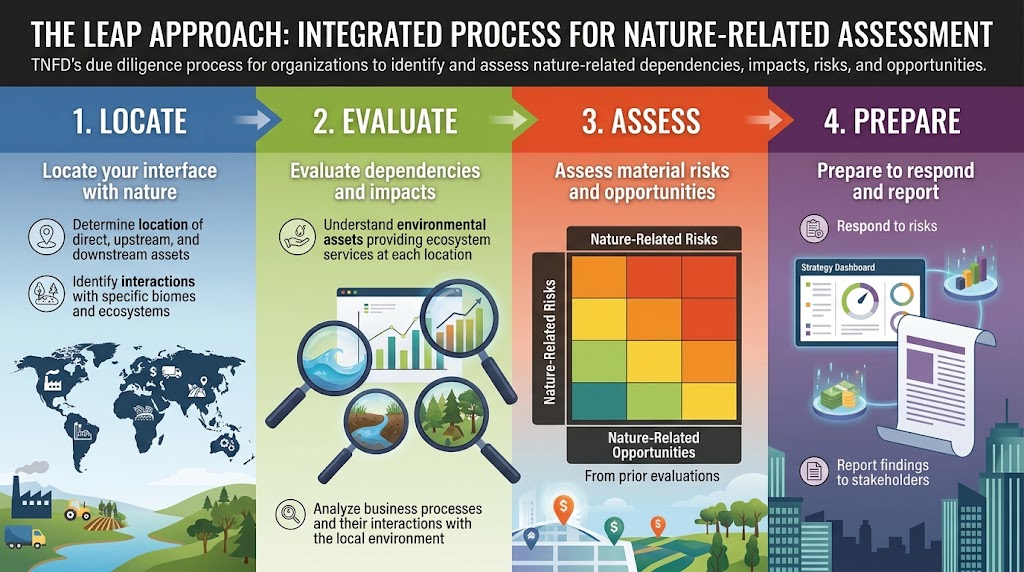
To help implement these recommendations, the TNFD developed the LEAP approach—an integrated process for identifying and assessing nature-related dependencies, impacts, risks, and opportunities. It is useful for all organizations to conduct proper due diligence:
- Locate: Locate your interface with nature. Determine where all of your direct, upstream, and downstream assets are located and which specific biomes and ecosystems they interact with.
- Evaluate: Evaluate your dependencies and impacts. Develop a clear understanding of the environmental assets providing ecosystem services at each location, including business processes and their interactions with the local environment.
- Assess: Assess the material risks and opportunities stemming from those evaluations.
- Prepare: Prepare to respond to those risks and report the findings to stakeholders.
“Aligning financial and business decisions with nature is the most critical step we can take to contribute to sustainable prosperity for people and the planet.”
References and Further Reading
The concepts and definitions established in this guide draw upon the foundational work of the following scientific, economic, and regulatory bodies:
- Convention on Biological Diversity (CBD). (1992). Article 2. Use of Terms. United Nations.
- Intergovernmental Science-Policy Platform on Biodiversity and Ecosystem Services (IPBES). (2019). Global Assessment Report on Biodiversity and Ecosystem Services.
- Levin, S. A. (2009). The Princeton Guide to Ecology. Princeton University Press.
- Taskforce on Nature-related Financial Disclosures (TNFD). (2022-2023). Recommendations of the Taskforce on Nature-related Financial Disclosures.
- United Nations System of Environmental-Economic Accounting (UN SEEA). Ecosystem Accounting Framework.
- World Economic Forum (WEF). (2020). New Nature Economy Report II: The Future of Nature and Business.
Leave a Reply